Page copy protected against web site content infringement by Copyscape Add this blog to my Technorati favorites
Showing posts with label pakistan. Show all posts

Tuesday, March 30, 2010

The New Great Game in Afghanistan

Bookmark and Share
Background
Afghanistan has been an unfortunate and poor country for quite sometime. It has consistently witnessed intervention of the foreign powers into its internal affairs. After the two superpowers fighting their turf battles in Afghanistan, it is now the turn of two regional powers India and Pakistan to do the same.

It must be understood that for Pakistan, Afghanistan holds the similar importance like Nepal does for us. We do not wish to control Nepal and would like a peaceful stable Nepal. At the sametime we are alarmed by growing Chinese presence in Nepal. Similarly, Pakistan is alarmed by growing Indian presence in Afghanistan. Thousands of Nepalese are allowed to live and work in India. Likewise, Pakistan hosts about 3 million Afghans.

However, the similarity ends there. Pakistan has used Afghans to promote cross border terrorism into India. Thousands of Afghans families have been settled in POK which is in direct violation of the UN resolutions. This is something that India has always respected. Article 370 of Indian Constitution does not permit outsiders to buy land in Kashmir. Kashmiri women who marry outsiders cease to have any property rights. Thus, the demographics of Indian Controlled Kashmir hasn't been altered at all in the last 60 years.

On the other hand, India has always assisted the Nepalese Govt in developing its economy. It helped its Army in its struggle against the Maoists. It has invested in various infrastructure projects in Nepal. But ofcourse, India has also tried to interfere in the internal affairs of Nepal, but that has been essentially to keep the country stable. Nepal hosts a large number of Tibetan migrants from China. India has never tried to use them to promote insurgency and terrorism into China or even give any such impression. This is precisely the difference between the approaches of the two countries.

Indian presence in Afghanistan
It is a well known fact that it was Pakistan's ISI along with the CIA that created the Taliban. After the fall of the Soviet Union, the Americans pulled, but the Pakistanis continued to support them. After the Taliban captured power in 1996, it was the Indians who continued to support the Northern Alliance. They continued to pump in money through the Tajiks. Eversince the Taliban were overthrown, India has actively invested in Afghanistan but has restricted itself to development project only. Some of the major projects are given below: (Source)
  • Committed $1.3 billion on various projects.
  • Built the 218-km Zelarang-Delaram highway to enable south-western Afghanistan to access the Iranian port of Chabahar.
  • Constructed the 220KV DC transmission line from Pul-e-Khumri to Kabul and a 220/110/20KV sub-station at Chimtala.
  • Built the Salma Dam power project (42 MW) in Herat province (to finish by 2011).
  • Constructing the Afghan parliament building (to be completed by 2011).
  • Helped expand the Afghan national TV network, provided uplink and downlink facilities over all of Afghanistan's 34 provinces.
  • 84 small projects in areas of agriculture, rural development, education, health, vocational training and solar energy.
  • Gifted three Airbus aircraft along with essential spares to Ariana Afghan Airlines. Also, 400 buses, 200 mini-buses and 105 utility vehicles.
Impact of Indian presence
There is absolutely no doubt that Indian presence has made a significant impact as well as a significant dent in Pakistani influence in the country. For e.g., the Indira Gandhi Hospital in Kabul is the only major Hospital in the country and has brought in tremendous Afghan goodwill. Other projects in the field of edcation, power and rural development have also made significant impact. However, nothing has made a bigger impact than the Indian made highways to Iran and Tajikistan.

 Thanks to an Indian-constructed bridge in 2007 linking Afghanistan and Tajikistan, trade through that route increased sevenfold within a year and Afghan land values along that route shot up dramatically. Not to be outdone, Russia too has offered to facilitate a rail transit corridor linking Europe to Afghanistan via Uzbekistan. Increasing Afghan involvement in Central Asia can spin off and spill over, positioning it to capitalise on its natural endowments and become the regional hub of water resources, energy distribution and hydroelectric power. Indian completion in 2008 of the 135-mile road from Nimroz province to Iran's Chahbahar port provides an efficient transport corridor for goods between Central Asia and the Persian Gulf.
With the Khyber Pass under constant attack, this insurgent-free route could provide an alternative for supplying western troops with non-lethal goods and aid to the Afghan government. This would cost Pakistan economically as well as geopolitically since currently 75 per cent of non-lethal supplies are transported through the port of Karachi. If the US is able to reopen its base in Uzbekistan as planned, Pakistan's influence will erode even further. (Source)
Till date, Pakistan has refused to allow Indian Goods to reach Afghanistan through its territory. These are now being pushed through the Iranian ports. The biggest consequence for Pakistan is that these economic trends are creating conditions for a de facto partitioned Afghan state. The more stable north and west - with international linkages, economic growth and acceptance of the Afghan central government and western troop presence - can emerge self-sufficient and defensible while pockets of insurgency engulf the south and east.

Pakistan's counter strategy
Pakistan has realised that it needs to counter the growing Indian influence in the region. Firstly, it began attacking Indian missions in Afghanistan. The result of this has been disastrous. For the moment, India has decided not start any new projects in the country and is content with completing the existing projects. Secondly, Pakistan has started accusing India of promoting insurgency in Balochistan. This is again a well thought out strategy. Afghanistan is under US command and it is impossible for India to do anything their knowledge. Moreover, Pakistan media barely talks about Baloch terrorists. They dont have capabilities to conduct Lahore type attacks. This is just a diversionary tactic by Pakistan and quite similar to accusing India of stealing Indus river water. (Refer my earlier article)

Thirdly, it seems to have convinced the US to have talks with moderate factions of the Taliban where it could play a major role as a facilitator. They have found an able ally in the form of the current Afghan President Hamid Karzai. Karzai too supports talks with the Taliban. In the elections last year, the US supported his rival Abdullah Abdullah, which was seconded by India. Now, Karzai is hitting back and has made overtures to Pakistan. He called Pakistan and Afghanistan as conjoined twins - even though one is over 5000 years old while other is barely 63 years old and it is not certain whether it will remain forever.

Pakistan successfully kept India out of the London Conference on Afghanistan where it was essentially decided to open a dialogue with the Taliban. Several Taliban leaders were removed by US from its list of most wanted terrorists. Pakistan has increasing become more assertive with its demands. They presented a 56 page document containing their demands - something like the old trade unionists, in the hope that atleast some of them will be addressed. As of now, Pakistan will be given more F-16's and drone technology will also be transferred.

However, what the US fails to understand that despite all the money that it has pumped into Pakistan, the people of Pakistan remain deeply suspicious and anti-American. This is essentially because till date it has restricted itself to pumping money into millitary hardware, something that has not touched Pakistani lives. This is precisely what Kerry Lugar bill hoped to achieve. However, there was massive opposition particularly from the Army as there were provisions to monitor the usage of money every six months and the aid was conditional (only released if Pakistan remain under Civilian rule). This directly threatened the Army's hegemony. However, by directly dealing with the Army, the US has essentially weakened the Civilian Govt. instead of of strengthening it.

Possible Indian Strategy
India must realise that its laid back strategy and depending solely on US cannot work anymore. Under the 8 years of Republican rule of George Bush, India enjoyed a strong relations with the US. However, the Democrats do not seem to be bothered about Indian interests too much. India has to do everything to convince the Americans of reducing their reliance on Pakistan. One possible ally in this great game is Iran.

Iran, a neighbouring Islamic country, has tremendous stake in a stable Afghanistan. Afghanistan produces nearly 90% of the World's poppy, which is also a major source of revenue for the Taliban. Being a neighbour, the Iranians have a major drug menace in their country. They would also like the radical elements to be kept away from their territory.

Iran is among the more modern Islamic countries. It is a democractic country. Its HDI index was 0.782 which is extremely good. It has a literacy rate of 83% and women comprise of more than half of the students in universities, something unthinkable in the most of the Islamic world. Therefore, rather than the military ruled and radicalised Pakistan, it should be Iran with whom the US should be dealing with.

However, this may not be as easy as it sounds. Firstly, the US had overthrown an elected Iranian Govt. in 1953 and installed a pro-US regime. This was done primarily to keep US energy interests. However, the 1979 Iranian revolution overthrew the pro-US regime. Iran has remained under US sanctions since then. In last few years, Iran has increasing felt threatened by the US, particularly after the US invasion of Iraq, which also driven by Oil interests. Iran has therefore decided to take the North Korea's path and is developing Nuclear Weapons to deter the US from attacking. Secondly, Iran being an Islamic country is opposed to Israel's occupation of Gaza and other territories. Israel has historically enjoyed good relations with the US. With US openly criticizing any fresh Israeli settlements in Gaza, this could be the time to reach out to Iran.

Another possible ally is Russia. Russia again another neighbour that has stake in the stability of Afghanistan. Russia too has faced terrorism from Chechen rebels who have close links with the Al Quaeda operatives. The Russians who withdrew from Afghanistan in 1989 are still believed have their intelligence presence in that country. But Russia again has been a long time US enemy strethching back to the Cold War era. However, recent agreements between Russia and US to reduced their nuclear warheads is a sign that the things are changing.

India which enjoys close relations with Russia and has had close relations with Iran in the past. If India could help strengthen the relations of the US with Russia and Iran, something similar to what the Pakistanis did to US-China relations, it could completely change the game in Afghanistan.

Final thoughts
As Pakistani Foreign Minister Mr Qureshi puts it, "Indian and Pakistani interests in Afghanistan cannot be the same". Ofcourse, one is development oriented while other is not.

Monday, March 1, 2010

India and Pakistan - future scenario

Bookmark and Share
Thank You Blogadda :)

Sixty three years ago, the two countries started their journey, torn by bitter memories of partition. The relations between the two nations have been troubled right from the start. Two similar examples from around the world the come to mind - West Germany and East Germany, and the two Koreas.

There are some basic similarities. These countries too had to go through a bitter partition. They followed different political systems and were bitter rivals of each other. One essential difference is that they essentially were one country - i.e. both East and West Germany claimed that they represented the entire Germany. Same is true in case of North and South Korea. In case of India and Pakistan, their rivalry is essentially over Kashmir. Though India was earlier a united country, it is extremely unlikely that partition can be reversed.

The German Story
After the Second World War, both East and West Germany were essentially poor and devastated. But West Germany under the allied influence, introduced free market reforms. It also benefited by large scale aid by the US. By the 1960's and 70's, there was large and visible difference in conditions on the two sides of the border. People in East Germany wanted to move to the West in search of a better life. The Berlin Wall was constructed to stop this. The difference in living standards continued to increase. Perhaps it was the aid from Soviet Union that was keeping things just about together in East Germany. In late 80's, Soviet Union was badly battered in Afghanistan. As a result, it could not continue its aid to the East. The Berlin Wall collapsed.

The Korean conundrum
The story between North and South Korea is somewhat similar. Both countries have remained bitter rivals since the end of the Korean War in 1953. Both countries have contrasting political and economic systems. While North Korea is a totalitarian dictatorship with centralized economy, South Korea is a democratic country with free markets. North Korea implemented land reforms, introduced free health care and education. At one point of time, its HDI indicators were better. However, gradually South Korea's export led economy has moved way ahead. Today its HDI indicators are much better. Its per capita income is $20,000 as compared to a minuscule $1100 in North Korea.

Sung Yoon Lee in his article in ForegnPolicy says,
In contrast, beyond North Korea's southern border lies a free and affluent Korea, one that claims sovereignty over the entire peninsula and to which millions of Northerners would move if given the choice. By its mere existence, Seoul poses an omnipresent existential threat to Pyongyang.
In his article, Lee predicts that North Korea like East Germany cannot survive forever. It will collapse at some point of time. It must be noted that it currently receives aid from China (just like East Germany did from Soviet Union) and South Korea without which vast proportion of its population would die of hunger.

Comparing India and Pakistan
Can such an eventuality occur in the Indian Subcontinent ever. On one side we have India, a democracy (with its own flaws), an rapidly growing economy and rising living standards.But it is also the home the largest number of poor, there is growing rich-poor divide and a growing Naxal violence. On the other side of the spectrum is Pakistan, at best is a military controlled democracy, a country that is battling with an identity crisis, is a nuclear weapon state, is said to be source of terrorism worldwide.

Small signs of such a thing are present. Pakistanis today are worldwide seen with suspicion. They are lined up and frisked separately at airport. Many Pakistanis abroad claim themselves to be of Indian origin in order to escape this. Some Pakistanis artists like Musicians also want to get hold to an Indian Passport. Of course, these people are a small minority.

But is such a thing really possible. My answer to that will be for the moment, NO. The difference in prosperity in the two countries isn't that huge. India's rank according to HDI index is 134 while that of Pakistan is 141. As per Wiki, India's per capita income $1022 while that of Pakistan is $1017. Our Gini ratio is actually  higher at 36.8 as compared to just 30 for Pakistan. Historian William Dalrymple too writes that there is little difference.
On the ground, of course, the reality is different and first-time visitors to Pakistan are almost always surprised by the country's visible prosperity. There is far less poverty on show in Pakistan than in India, fewer beggars, and much less desperation. In many ways the infrastructure of Pakistan is much more advanced: there are better roads and airports, and more reliable electricity. Middle-class Pakistani houses are often bigger and better appointed than their equivalents in India.
However, he goes on to point out some major differences - landholdings. democracy and education. Soon after independence, land reforms were introduced in India. This was promised the Congress. In fact, this is often referred as one of the reasons of creating Pakistan, (protecting the interests of Zamindars). In Pakistan, this feudal system still exists and as a result there is inequality and social tension. Pakistan has seldom enjoyed Democracy. However, often freedom is difficult to directly quantify when it comes to measuring prosperity. Regarding education in Pakistan, he writes
No problem in Pakistan casts such a long shadow over its future as the abject failure of the government to educate more than a fraction of its own people: at the moment, a mere 1.8% of Pakistan's GDP is spent on government schools. The statistics are dire: 15% of these government schools are without a proper building; 52% without a boundary wall; 71% without electricity.

This education gap is the most striking way in which Pakistan is lagging behind India: in India, 65% of the population is literate and the number rises every year: only last year, the Indian education system received a substantial boost of state funds.

But in Pakistan, the literacy figure is under half (it is currently 49%) and falling: instead of investing in education, Musharraf's military government is spending money on a cripplingly expensive fleet of American F-16s for its air force. As a result, out of 162 million Pakistanis, 83 million adults of 15 years and above are illiterate. Among women the problem is worse still: 65% of all female adults are illiterate. As the population rockets, the problem gets worse.
Currently, India's literacy rate is 65% and should increase to 80-85% by 2030. One obvious concern here is what is the quality of this education and are these people employable. And I am sure even in India, there are schools that don't have proper building or electricity(particularly in the Naxal belt).

Nevertheless, India is way ahead of Pakistan in terms of education. But another concern is that a large proportion of the population receives education through the outdated Madrassa system.The so-called secular forces are merely promising reservations for them, even though in 60 years, reservations haven't made enough impact on SC's and ST's. Reservations were supposed to be an instrument that removes the caste identity. Instead it has only strengthened it. A divide based on religion is even more dangerous. Ironically, it has been the so-called communal party that has talked about reforming the madrassas, something that has been looked with suspicion by the community.

Future Scenario:2030
Where will be in 2030 economically, this is an important question. Will there be any difference in level of prosperity with respect to Pakistan change?

Over the last 20 years our economy has grown consistently. In the last five years, we have grown by nearly 8%. There are rumors that we are capable of achieving 9-10% growth rates. Let us assume that we will grow at an average of 7% over the next 10 years and at 5.5% in the subsequent 10 years. The growth rates will come down because of base-effect. Despite these highly conservative estimates, India's GDP would be at least 4.2 trillion dollars. Our rate of population growth has been coming down consistently and present it is roughly 1.55% (Source). Assuming an average growth rate of 1.45% over the next 10 years and an average of 1.35 over the subsequent 10 years, our per capita GDP should be roughly 2700$ in 2030.

What would the number be for Pakistan? Under Musharraf, from 2002 to 2007 Pakistan did post impressive growth of 6-7%. But such stability in the country is rare. In 2009, the growth rate was just 2%. Assuming an average growth rate of 4% over the next 10 years and 6% over the subsequent 10 years(highly optimistic considering the frequent bomb blasts and terror attacks), in 2030 Pakistan's GDP would just be $436 billion. Assuming its population grows at 2% and 1.8% as against present figure of 2.2%, its per capita income would in 2030 would only be around $1800.


These are highly conservative estimates and the real picture might actually to be much much better than this.For example, considering current education levels in Pakistan it is highly unlikely that they can sustain such growth rates of 6% over such long periods. Despite this conservatism, India's GDP would be 10 times that of Pakistan while per capita GDP would  be 1.5 times. More likely figures are that our GDP will be 14-15 times that of Pakistan and per capita GDP will be around 2.5 times that of Pakistan.

Impact of this growth

India's GDP would be at least 10 times that of Pakistan. In another five years time, India's economy would overtake China as the fastest growing economy. This should translate into enormous leverage for us. Around 10-15 years ago, China's human rights record was severely criticized everywhere. But one hardly hears that today. China's influence was very much visible at Copenhagen.

India is bound to enjoy similar influence by 2030 or even before that. By 2030, India would have almost certainly hosted the Olympics. We are not even sure whether Pakistan could host even the Asian Games by then

I do not foresee a Germany like situation which led to the reunification of Germany. But I do expect that if there is appreciable difference in prosperity and if this grow is inclusive, domestic support for terror is should come down appreciably.

Another important thing is that if there is an appreciable and visible difference in prosperity, it shall become increasingly difficult for the Pakistani Military to continue with its astronomically high defense expenditure. Presently India spends around 2.5% of the GDP on defense while Pakistan spends around 3.5-4%. Hence, in 2030 our defense budget should be close to 100 billion dollars ( 2.5% of 4.2 trillions). This would be 25% of the Pakistan GDP in 2030. Naturally Pakistan would try and match India's defense expenditure by increasing its defense to atleast 8-10% of the GDP.

There would be increasing public pressure against this and unrest among the people would rise. This would result to much more Army control over the civilian Govt and military highhandedness. Thus most probably by 2030 Pakistan would under direct Military control.Furthermore, the increasing military asymmetry would force Pakistan to lower its nuclear doctrine. Thus the sub-continent would actually become a much dangerous place in 2030.


Limitations of this analysis
The methodology of this analysis just too simple to cover everything. First, the GDP figures are based on nominal values rather that PPP. Using purchasing parity method, the comparative figures would actually improve significantly for India.

Secondly, India has been lucky to have stable Govts. at the centre since 1999 and increasingly governance is becoming the sole criteria that is used by the people while voting. What if there is a hung Parliament. India has previously witnessed this during the 1989-91 and 1996-98. During this period, the growth was minimal and reforms were stagnant.

Thirdly, merely achieving these growth rates are not sufficient. Whether this will translate in improve in prosperity. Whether this growth will be inclusive. Whether all communities including the Muslims who are currently lagging behind in all social indicator be a part of this growth. Will the Maoists be suppressed. Will the development reach the Naxal belt.

Finally, will there be any war either with Pakistan or with China. War could change the above numbers. Of course any resolution with either of the two will also improve the numbers vastly.


These are extremely difficult questions and only time tell. However, if India plays its cards well, great glory is awaiting us. For Pakistan, it is important to understand that India's rise is inevitable. It will be their choice whether they would like to be a part of this growth or not. It is therefore important for Pakistan to understand that going forward, they will not be able to compete whether militarily or economically.

Saturday, February 6, 2010

Why is India be talking to Pakistan

Bookmark and Share
This is a billion perhaps even a trillion dollar question and  there are no clear answers. India suspended its talks with Pakistan after 26/11 attacks indefinitely asking Pakistan to stop terrorism from its soil and to punish the accused in the 26/11. Other than the arrest of Lakhvi, there is little to suggest that Pakistan has done anything on that front.

So why then are talks been restarted
I believe one of the major reasons for that are the recent developments at the Afghanistan Conference in London. With a struggling economy at home and lack of public support, Obama is in no mood to fight the War in Afghanistan indefinitely. At the London Conference, it has been decided that the moderate elements in the Taliban would offered a stake in Afghan Govt.

This is where Pakistan can play a major role. It can use its contacts in the Afghan Taliban to bring them to the negotiating table and thus ensure that the Americans can have an honorable exit. But this also means that Pakistan is going to bargain hard to keep India's role in the Afghan reconstruction to the bare minimum. There are some signs that show that the West has agreed to it. Furthermore, there was a renewed International pressure on India to resume talks. Afraid of losing all the strategic gains made by India in Afghanistan by investing over $2 billion, it was thought that Indian interests could be best served by re-engaging with Pakistan.

Why are people opposing talks?
Several voices including those in the BJP are opposed to resumption of the composite dialogue process at this point of time. According to them Pakistan's Army continue to be India centric and have done little to contain the anti-India forces.

This is absolutely true and the Pakistan Army continues to view them as strategic assets. Recently LeT organized mass rallies at POK and Lahore. Infact the rally at Lahore was barely a few kms away from Punjab Assembly. The Prime Minister of Pakistan has publicly said that he cannot guarantee that there shall be no further attacks. But why can't he limit such anti-India forces. Is Pakistan really serious about peace?

The Pakistan argument to the above question is that Pakistan is fighting its own war on terrorism. It has already been said that the current operation would take atleast a year to defeat the TTP. At this point of time, the Army does not wants to open another front with the anti-India forces. The LeT, due to its anti-India stand enjoys massive support in Pakistan. LeT has limited global ambitions and is largely focused on India. It has not allied with Al-Quaida. It is because of these reasons that Pakistan isn't too keen on fighting them at the moment. They are merely arresting them for a while before releasing them again.

What to expect from talks
Personally, I don't have much hopes from the talks. Pakistan would not allow any progress to made unless Kashmir is discussed. It would raise ridiculous issues such as Balochistan and comparing it with terrorism in Kashmir. Balochistan and India do not share any border and the Baloch population is just 4% of the total population of Pakistan. Even if India ever wants, it cannot bleed Pakistan in the same way as Pakistan bleeds us. As far as the issue of Kashmir is concerned, it is highly unlikely that any solution that is acceptable to all the three parties can emerge anytime soon.

Secondly, I doubt whether Pakistan would really ever go after the likes of LeT or Jaish once its operations against TTP are complete. Once the American Guns in Afghanistan go silent and the US drones are withdrawn, I doubt if the US can exert sufficient pressure on Pakistan to act against the anti-India forces. Let us not forget that even before 26/11 India tried to get LeT banned by UN Security Council but it was always blocked by China (a Pakistan ally). I expect the Chinese to use their veto power to create more problems for India in the future.

So, if the situation demands that we talk to Pakistan then so let it be. But we should never trust this neighbor. India should build more dams in Kashmir, thereby creating a negotiating point for ourselves and make it difficult to them continue their proxy war. All major rivers in Pakistan pass through Kashmir this building dams can helps in driving our point through.

We must build up additional negotiating points. India has to be prepared to fight its war on its own. Aman Ki Asha cannot be done without Aman Ki Bhasha from your opponent. This is a game, and that the moment its our adversary who has the advantage.

Sunday, December 27, 2009

Looking back at history: Hijack of Fokker Aircraft in 1971

Bookmark and Share

The year 2009 is coming to an end, and touchwood, we haven't had any major terrorist strike.Indian Home Minister recently admitted that luck played an important part in this - the Indian intelligence agencies need to be lucky every time, the terrorists need to be lucky just once.

So are Indian intelligence agencies who are often criticized and termed ineffective, really that bad? In this article, I am going to discuss a very old incident, Hijack of Fokker Aircraft, which happened just before the 1971 India-Pakistan war. Most Indians would be unaware of this incident.

Let me add a caveat before I continue with my article. This article contains my understanding of the incident and is based on my various reading I have done on this topic. This may or may not be the actual description of the events. India has never officially acknowledged its involvement for obvious reasons. It is unlikely to do the same ever, in pretty much the same way as Pakistan is unlikely to accept its support for terrorism.

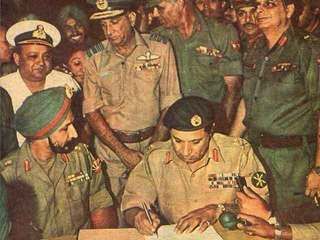
Creation of Bangladesh was perhaps biggest ever success of RAW. The Fokker incident occurred before the start of the war but it proved to be an important event.

Background
India and Pakistan had been quarreling over Kashmir ever since independence. They had fought two wars in 1948 and 1965. By 1970, cracks began to appear between the West and East Pakistan - its two wings.

East and West Pakistan were separated by more than 1000 miles. Soon after independence, Urdu was proclaimed to be the national language of the wings even though Bengali was spoken by a majority of the Pakistanis. The Bureaucracy and Army was dominated by Punjabi's. There was considerable resentment among the East Pakistanis over dominance of the West.

President Yahya Khan held fair and free elections in December, 1970 in which Awami League of Shaikh Mujibur Rahman won a majority largely due to his Six-Point manifesto. National Assembly was to hold its first session in Dacca on 2nd March, 1971. It was, however, sabotaged by vested interests of West Pakistani establishment and some leading politicians, who were not willing to accept a Bengali-led government. (Source)
By March, Pakistani army resorted to use of force and decided to crush the political movement. Mujibur Rahman was arrested and sent to prison in West Pakistan. The use of force was excessive and large number of Bengalis were killed. A huge number of Bengali women (mostly Hindu) were raped by the Pakistani army. Survivors have compared it to the Nazi extermination of Jews. This led to a large number of Bengalis seeking refuge in India. India decided to extend all help to the refugees.

Strategies
India and Pakistan had two different strategies. Pakistan was aware that India could come to help the East Pakistanis. Therefore its plan was to devote more men and material for West Pakistan.

The Pakistanis would concentrate their forces in the West and thereby aim at capturing as much as Indian territory as possible. The Indians, on the other hand, would be fighting a war on two fronts (while at the same time keeping a fearful eye on the Chinese borders). Given this scenario, the Pakistanis felt that India at best would be able to capture some territory in East Pakistan and lose quite a bit in the West. In the end, the Pakistanis knew that the Western powers would intervene to stop the war and what would matter is who had the most of the other's territory. (Source)

They were hoping for a stalemate just as had happened during the 1965 War. Indian plan was essentially to liberate East Pakistan as quickly as possible. On its Western sector, it had essentially planned to defend with much smaller units and had much fewer offensive plans.

The Fokker incident
On January 30,1971, brothers Hashim and Ashraf Quereshi of the Jammu & Kashmir Liberation Front, armed with a pistol and a hand grenade, hijacked Ganga, a Fokker Friendship aircraft of the Indian Airlines (IA), after it had taken off from Srinagar for Jammu and forced the pilot to take it to Lahore.

After the aircraft had landed, Zuklfiquar Ali Bhutto, then Foreign Minister under Yahya Khan, rushed to Lahore, fraternized with the hijackers and helped them get maximum international publicity for their cause. On February 1, he persuaded them to release the crew and passengers who were sent by road to Amritsar. (Source)

Was the hijack staged
Pakistan has consistently alleged that this hijack was staged by Indian intelligence agencies. Soon after the hijack, India banned all Pakistani flights over its airspace. This meant that the distance between West and East Pakistan became three times the orginal distance and thus made it more difficult for Pakistan to transfer resources from West to East. It may have played its part in the overall outcome of the war.

The aircraft was hijacked by two Kashmiris, Butt and Hashim Quereshi. One of them was a Border Security Force man. What made the affair curious was the fact that Ganga was one of the oldest aircraft in the Indian Airline fleet and was already withdrawn from service but was re-inducted days before the 'hijack'. Even more tellingly, a deputy inspector general of the BSF based in Jammu, bristling at the involvement of one of his men in hijack, had gone public to say that he had objected to the induction of Butt into the BSF but was overruled by a 'higher intelligence agency'. (Source)
Conclusion
From the prima facie , it does appears that the hijack was staged by Indian intelligence agencies. In hindsight it appears to be clever plan that worked perfectly. Though there are some unanswered questions. Like why was Quereshi arrested by Indians when he returned back to India.

This surely is gratifying for an ordinary Indian that its intelligence agencies are capable enough to do something like that. Indian agencies have consistently maintained a low profile as compared to other agencies like CIA or Mossad. There are rarely any publicity or movies made on RAW's operations.

The reasons are best known to the people in-charge. I only hope that they are still carrying on their good work.

Saturday, September 19, 2009

A blog from across the border

Bookmark and Share
I came across this blog from a Pakistani. This is first time I have come across a Pakistani blogger who has shown the guts and honesty to criticize the Pakistani psyche and thinking. Unfortunately there aren't too many of them. Most of them agree with the monolithic anti-India view propagated by the state and the ISI.

Saturday, August 15, 2009

1965 War - Part 1

Bookmark and Share
I wish all my readers a very Happy Independence Day. So finally, I am here with the first part of the summary of the 1965 War. I know I am a little as promised. The primary reason for that is that I got hold of the Official History of 1965 War of the Indian Govt. I going through it, though not in absolute detail, but still I guess this report is more detailed than any articles found on the internet. At the same time it must be noted that this is a document of the Indian Govt. and hence may be biased to some extent.

Soon after the War, the Army HQ in Pakistan ordered all the formations and units of the Pakistan Army to destroy their respective war diaries.(Source) Hence, the Indian version shall be the main source of my briefing. In case anyone of you comes across any credible source for the Pakistani version, kindly pass them on. In the meantime, I shall try to put forward the Pakistani version from wherever I can. But at the end of the day, I am an Indian, and it might not be as unbiased as I want.

Background
India and Pakistan, both had been claiming Kashmir ever since 1947. But since ceasefire in 1948, there had been no military conflict between the two nations. Meanwhile Pakistan pursued to internationalize Kashmir and tried its best through diplomacy. In 1962, India suffered a crushing and humiliating defeat at the hands of Chinese. Pakistanis now began to believe that India could be militarily defeated.

India had not invested much in defense up until 1962. But things began to change as India started investing in defense. It also got some defense aid from US and UK in the form weapons who were alarmed at the rise of communist China.

Meanwhile, Pakistan had invested and modernized its defense forces. Moreover, being a part of US led millitary alliances SEATO and CENTO, it got access to the latest weapons. In 1963, Pakistan ceded Aksai-Chin to China and thus began a friendship which had a common enemy, India.

Integration of Kashmir with India
It must be noted that Jammu & Kashmir had not been fully integrated with India. Article 370 guarantees a special status to the State. Under this, Indian Parliament had limited rights over the State Govt. and citizens of India outside Kashmir cannot buy property in the state. Nehru successor Shastri was trying to integrate the state. This made the Pakistanis nervous.
Pandit Jawhar Lal Nehru's successor Lal Bahadur Shastri, rushed through a series of "Constitutional amendments, ( Articles 356 and 357 of the Indian Constitution ) despite strong opposition." The aim was to bring the State of Jammu and Kashmir in line with other States of the Indian Union. The head of the State under new law was not to be elected by the State Legislature, rather the Delhi government had a right to nominate anyone. Also under the new law four seats were allocated in the Indian Parliament, Lok Sabha, to the State of Jammu and Kashmir. And for the first time the Kashmiri people would contest for seats in the Indian Parliament. This really meant a gradual erosion of the Article 370 which gave special status to Kashmir. There was a strong reaction to this in the Valley. Sheikh Abdullah declared on May 7 1964, that ‘no solution will be lasting unless it has the approval of all the parties concerned, namely India, Pakistan and the people of Kashmir’. (Source)
Objectives
India and Pakistan had two completely different objectives for the war.

With India trying to integrate J&K with itself and increasing defense expenditure, Pakistan felt nervous. They saw that this was their chance to attack India (at a time when it was weakened by the 1962 War), and take Kashmir, something they haven't been able to achieve diplomatically.

On the other hand, Indian objectives were rather defensive. India sought to maintain status quo of Kashmir. It also didn't want to escalate the conflict too much.

I shall analyze at the end where things stood at the end of the war and were objectives of the two sides met.

Pre-War Clashes in Rann of Kutch
Skirmishes at the Rann of Kutch flared up almost accidentally in the Spring of 1965, and India and Pakistan found themselves drawn into the first of their two undeclared wars.

The dispute goes back to the days of the British rule in India. The Rann was the bone of contention between the princely state Kutch, and the British Indian province of Sindh. When British India was partitioned, Kutch acceded to India and Sindh to Pakistan. The issue was inherited by these two states along some 3,500 sq. miles of territory.

It is important to understand the terrain to region first. The Rann is a Salt Wasteland. It is a sparsely populated area and does not have enough water. Prior to the clashes in 1965, the area was under India control. Northern portion of the Rann was easily accessible from the Sind(Pakistan) as their were roads available leading upto the Rann. The India side wasn't well connected with roads.

Communications also favoured the Pakistanis as Indian Administrative base was located at Bhuj, 177 km away the border. Badin, a sizable town equipped with an airstrip and radar was available only 30 kms from the border. Thus maintainance of border posts was easier for Pakistan than for India.

The conflict started after an increasing number of Pakistani intrusions took place. Indians established a new post closer to the border called Sardar Post and Pakistanis retaliated by also having a new post. India also carried on a joint exercise of the Army and Navy called Arrow Head in the region. This alarmed the Pakistanis. In early April, Pakistan attacked the Sardar post and thus began the conflict in the Rann of Kutch. The conflict ended on 28th April when British Prime Minister Harold Wilson convinced the two sides for a ceasefire. A tribunal was setup to look into the issue. This tribunal later gave 350 sq. miles of territory out of the total of 3500 to Pakistan.

As far as the conflict in Kutch, India forces suffered a defeat at the hands of the Pakistanis. Despite getting intelligence about the Pakistani troop movements, the India effort was largely uncoordinated. I will quote from the Official History, "For India, Kutch was wrong war with the right enemy at the wrong place. For Pakistan, it was a victorious war out of which it learnt the wrong lesson that it could win a cakewalk victory in Kashmir".

Kargil Operations
In May, 1965 after defeating India in the Kutch, Pakistanis increased their activities in the Kashmir along the CFL( Ceasefire Line). From what appears, it seems that atleast a part of Kargil (if not all) was under Pakistani control in 1965. As during the 1999 Kargil Conflict, Pakistanis shelled at the Srinagar-Leh highway the only supplyline for Ladakh.

Indian Army decided to take on the enemy and to inflict maximum damage. It was planned to capture certain strategic peaks in Kargil. The situation and tactics used in 1965 weren't quite different from 1999. The terrain was extremely difficult, the temperature were sub-zero and the enemy at a height had an advantage. Indian Army choose to attack through the more difficult approaches to these mountains. This was the first counter-offensive operations taken by the Army in many years.

The operations were extremely successful and Indian captured some of the importants areas like Pt 13620, Black Rocks and Kala Pahar. However, the hard fought areas were given up on June 30 after a solemn assurance by the UN Secretary General about the safety of the Srinagar-Leh route.

Conclusion
Pakistan came out victorious in Round 1 in Kutch while Indians won the Round 2 in Kargil. However, it must be noted that Pakistan had a advantage of the terrain in their favour on both occassions. On both occasions, it was the international community that played a crucial role is de-escalating the conflict. In the next part we shall look in the events of the actual war.

Sunday, July 26, 2009

Kashmir predicament: Who really started it?

Bookmark and Share
India and Pakistan, the two nations that were divided on religious lines have been at loggerheads from the very beginning onwards. Of the many issues on which the two sides confront each other, Kashmir remains to be the central and core issue. But today, it has become an extremely complicated issue and no real solutions have come up that would satisfy the two sides.

So what really started the conflict?
All princely states were given an option to either accede with India or Pakistan, or remain independent. Though the third option of remaining independent was given, it was made clear that the princely states could hardly survive on their own. This was true for the landlocked state of Kashmir as well, as it would have to necessarily depend on either on India or Pakistan for trade.

However, the Hindu ruler of largely Muslim dominated Kashmir, Hari Singh chose to remain independent. In October 1947, Pakistan invaded Kashmir. Hari Singh now chose to accede with India. Subsequently India sent its armed forces to recapture Kashmir. It must be noted that this was took place immediately after partition and India had much larger millitary as compared to Pakistan at that time.

After India had captured two-third of the state, Pandit Nehru against the wishes of his home minister, Sardar Patel went to the UN Security Council. He intentions were pure but he was an idealist and not a realist. UN Security Council passed Resolution 47 on April 21, 1948. The resolution imposed that an immediate cease-fire take place and said that Pakistan should withdraw all presence and had no say in Jammu and Kashmir politics. It stated that India should retain a minimum military presence and stated "that the final disposition of the State of Jammu and Kashmir will be made in accordance with the will of the people expressed through the democratic method of a free and impartial plebiscite conducted under the auspices of the United Nations.

However, Nehru soon realised that it was a grave mistake to take the matter to the Security Council. By 1948, the Cold war had began to start and the world politics was dominated and dictated by the big powers (US and USSR), who wanted to spread their influence with the Capitalist and Socialist blocs competing against each other. Pakistan never withdrew its troops from Azad Kashmir and thus the Kashmir dispute remained unsolved.

Other similar conflict
Kashmir isn't the only victim in the world of the selfish interests of the big powers. They created many other similar problems all over the world. Korea, Vietnam and Germany are some of glaring examples. While Germany's re-unification was peaceful, Vietnam had to fight a massive war. While USSR supported the communist North Vietnam, the US supported the capitalist South Vietnam. The Korea issue is yet to be solved and has now assumed dangerous proportions with the North Korea acquiring the nuclear capability.

If we look at all such conflicts, the two big powers rarely followed any ethics. For instance, during the 1971 Indo-Pak war, the US ignored the massive genocide that was going on in East Pakistan and threatened to intervene in the war.
The Nixon administration also ignored reports it received of the 'genocidal' activities of the Pakistani Army in East Pakistan, most notably the Blood telegram. When Pakistan's defeat in the eastern sector seemed certain, Nixon sent the USS Enterprise to the Bay of Bengal, a move which was a nuclear threat. The Enterprise arrived on station on December 11, 1971. On 6 December and 13 December, the Soviet Navy dispatched two groups of ships, armed with nuclear missiles, from Vladivostok; they trailed U.S. Task Force 74 into the Indian Ocean from 18 December 1971 until 7 January 1972. The Soviets also sent a nuclear submarine to ward off the threat posed by USS Enterprise in the Indian Ocean. As the United States were not ready to risk open nuclear warfare with the Soviets the Enterprise simply turned around and sailed back to the US. (Source)
This strategy of US didn't stop and it supported General Musharraf as the dictator of Pakistan until he was finally removed.

A lot many people in India blame Nehru for trying to be too idealistic. But it is the two big powers that must have to share the larger of the blame of creating the Kashmir issue, thus endangering nearly 1.5 billion people of the sub-continent. Subsequently, India has maintained that Kashmir is a bilateral issue while Pakistan has continuously tried to internationalize it.

Saturday, July 25, 2009

The mystery behind Balochistan

Bookmark and Share
I am pretty sure that except for a few inquisitive people, not many Indians would have ever heard about Balochistan before the ho-halla over the joint declaration in Egypt recently. In this article, I would try to disseminate whatever knowledge I have gathered on this topic over a period of time (through various sources).

Balochistan, an immense desert comprising almost 48% of Pakistan's area, rich in uranium and copper, potentially very rich in oil, and producing more than one-third of Pakistan's natural gas, it accounts for less than 4% of Pakistan's 173 million citizens. Strategically, Balochistan is mouth-watering: east of Iran, south of Afghanistan, and boasting three Arabian sea ports, including Gwadar, practically at the mouth of the Strait of Hormuz. (Source). Balochis are largely tribal and consider themselves much closer to the Afghans than the rest of Pakistanis.

When India and Pakistan eventually gained independence from the British in August 1947, provinces were given the choice of either joining Pakistan or India or being independent. Khan of Kalat, Mir Ahmed Yar Khan declared Kalat's independence. The Governor General Lord Mountbatten of Burma decided that the province would not survive as an independent entity and that offer was taken off the table.(Source)

As claimed by Baloch nationalists, "Baloch nation has gone through a lot since March 23, 1948, when the Pakistan army moved in and occupied Kalat, the capital of the free Balochistan. After experiencing only 227 days of freedom in which we elected our representative assembly and wrote a constitution as a free nation of this global village. Pakistan's army trampled every thing under their boots - Baloch nation's pride, freedom, representative assembly, constitution and mostly our mother land and declared it a part of Pakistan." (Source)

There have been several conflicts between the Baloch separatists and the Pakistan army:
  1. First conflict 1948 (led by Mir Ahmad Yar Khan)
  2. Second conflict (1958-59 led by Nawab Nowroz Khan)
  3. Third conflict 1963-69 (led by Sher Mohammad Bijarani Marri)
  4. Fourth conflict 1973-77 (led by Nawab Khair Baksh Marri)
  5. Fifth conflict 2004-to date (lead by Nawab Akbar Khan Bugti and Mir Balach Marri)
The Pakistani response to the demands of the separatists has often been brutal. Particularly in the mid-1970's, when Pakistani Army brutally crushed the Baloch struggle. Perhaps it came in the backdrop of recently lost war to India which had led to the creation of Bangladesh and Pakistan could not afford to loose another major province. In August 2006, Pakistani army killed Nawab Akbar Khan Bugti, 79 years old, a very respected leader of the Baloch struggle.

The Grievances
The Baloch struggle and their demands are not entirely unjustified. The local grievances have seldom been taken seriously. Islamabad pays a pittance in royalties for the Balochis for exploiting its natural resources, and development aid is negligible; Balochistan is treated as a backwater and the Balochis remain largely poor and illiterate.

Moreover, Pakistan has essentially been ruled by its millitary for most of its 60 years of independence. Even when under civilian rule, millitary has flexed its muscles and indirectly controlled the govt. Pakistani millitary has traditionally been dominated by Punjabis (Punjab constitutes 60% of the population of Pakistan). It is this domination by just one selected group that has aggravated the problem as millitary plays a major role in Pakistan in shaping the policies. It must also be noted that in the undivided Pakistan, the Bengalis were hardly given any representation either in the millitary or in the civil services and there a complete domination of Punjabis. This was a major (Source)

The Indo-Pak joint statement
This certainly isn't the first instance when Pakistan has accused India of fomenting trouble in Balochistan, nor is it the last such instance. It must be noted that India does not share any border with Balochistan and hence it cannot support the Baloch struggle (if at all it wants to) in the same way as the state of Pakistan does to the Kashmiri struggle.

Pakistan has also accussed that India is using Afghanistan's territory to launch attacks in Balochistan and is training Balochis. Ofcourse it is difficult to ascertain the truth since just like Pakistan has never accepted the alleged role of its Army and ISI for the terrorism in India, India is unlikely to ever accept such a charge.

But the problem now is that Pakistan has been successful in equating terrorism in India to terrorism in Balochistan. The two can hardly be equated.
  1. As already mentioned, India does not shares a border with Balochistan.
  2. Terrorist groups in Pakistan like LeT have launched daring attacks on the Indian establishment like the attack on Indian Parliament or the Mumbai attacks. On the other hand, Balochi attacks have been of a much smaller scale.
  3. The Baloch struggle existed even before the 2001, when the Afghanistan was ruled by the Pak-friendly Taliban. On the other hand, Kashmir struggle has almost from the very beginning, involved a Pakistani hand. This is true even in 1947-48 when Pakistani sent its armed forces under the cover of the tribals. This strategy continued in subsequent war of 1965 and Kargil war of 1999.
  4. The Baloch struggle is hardly given any coverage in the Pak-media as compared to the Taliban struggle. Clearly, Taliban is a far bigger threat to Pakistan.
  5. Soon after the attack on Sri Lankan team, Pakistani govt. denied any Indian involvement and instead pointed towards Taliban. However, now it wants to paint the Baloch threat to be much graver so that it can be equated to the terrorism that India is facing, and thus countering the advantage that India holds with respect to the world opinion.
Can Baloch struggle ever reach the same level as that of Kashmir?
In the 1971 war, India defeated Pakistan and helped in creation of Bangladesh. In that case, India was able to use the unrest in Bangladesh against the Pakistani rule to its advantage. Even if the Indian state today wanted to use Baloch struggle to further balkanize Pakistan, it would be extremely difficult, almost impossible.

As already mentioned, Baloch population constitutes just 4% of the total population of Pakistan. In such small numbers, they hardly can hope to win against the Pakistani state without external help. Moreover, India does not shares any borders with Balochistan. Lastly, Pakistani today has nuclear weapons and hence it is unlikely that there would be a full fledged war.

Therefore, Baloch struggle can never really threaten the Pakistani state. Perhaps thats the reason no govt. has been serious enough to look into their greviances. Balochistan is a tool to counter India, something that Pakistan has successfully used very skillfully.

Saturday, June 6, 2009

India:The Weak State?

Bookmark and Share
India has been called as a weak state numerous times, both by India and foreign experts. After every terrorist attack, such claims become even more common. Mumbai attacks were no exception to this and scores of socialites who were seen on News shows talked repeatedly about India being a weak state.

Some of the arguments that were made were just too ridiculous. Comparisons were being drawn between India and Israel or India and US. Why can't India hit-back like Israel? When Osama attacked US, it hit-back with an invasion on Afghanistan, why can't India emulate the same? If you visit some of the online forums, its is quite common for Pakistanis to ridicule the Indians using similar arguments.

A fact that is quite easily forgotten is that Israel has to deal with groups like Hamas and Hezbollah which neither have an air-force nor have any tanks or other armored force. India on the other hand is dealing with Pakistan, a nuclear power nation. The two are just incomparable.

India's comparison to US is even more ridiculous. It is often argued that after the 9/11 attacks, US constituted Homeland Security department and since then there haven't been any attacks on US soil. But what is easily forgotten that US is thousands of miles away from the epicenter of Islamic terrorism i.e. Pakistan, while India is just next to it. So it may be for US to invade Afghanistan without feeling any repercussions, but for India it is just not the same.

A better comparison would be to look at the recent happenings in North Korea and see if the US behaves any differently. North Korea conducted its second Nuclear Test last week. Simultaneously, it also conducted long range missile tests over Japan into the Pacific. It is believed that North Korea is now capable of hitting at least some of the US cities. Even though its weapons program is still at a very infant stage, the fear of nuclear weapons is immense. US allies in the region like Japan and South Korea were already in its range.

But the response from US has so far been measured. Apart from condemning the Tests, US seems to be working towards introducing fresh set sanctions and is presently looking to garner international support for same, particularly from China which has consistently supported the North Korean regime.

So where is the US bravado? It is quite obvious that US can't use the same tactics it used in Afghanistan here. North Korea has the fourth largest army in the World behind China, US and India. Its special forces are the largest in the World, believed to be around 180,000. It has developed long range missiles and now with its nuclear capability, it is miles ahead of Afghanistan.

Another reason why there is a perception of India being a weak state is because Indian Govt and their intelligence arm RAW have rarely tried to showcase its achievements and choses to remain in the background. We don't make movies on RAW while Hollywood keeps making movies showcasing CIA and its capabilities. The reasons are best known to the people in the higher echelons of RAW and I would not like to question that.

Perhaps the biggest achievement of RAW was breaking up Pakistan and creating a new entity called Bangladesh. If all the noises from Pakistan are to believed then RAW is actively involved in Afghanistan and Balochistan and is trying to keep Pakistan weak. The only problem is that it may take years before we get some results from their action. But that should not mean that they are not doing anything at all.

But since we are a democracy which offers right to speech, there will always be people to question the actions of the Govt. Hopefully this shall push it towards providing faster results on the ground.

I expect lots of readers may point towards India's bureaucracy and inefficiency, towards how there have been serious lapses, how there was a scan in bullet-proof jackets, and so. I do not discount that, but I would like to distinguish inefficiency in operations from strength or weakness in decision making. It is easy to call someone weak without looking into the challenges faced and also on its constraints of resources.

Thursday, May 21, 2009

What lessons can Pakistan learn from India

Bookmark and Share
I came across an interesting article in the Pakistani newspaper The Dawn. It talks about how deep the anti-India feelings exist in Pakistan. I suppose it would be wrong to say if similar feelings don't exist here. We can go arguing which one is more. It is in these circumstances that we fail to appreciate what is common among us and how both sides have something to learn from each other. The article talks about lesson Pakistan can learn from India. I am mentioning some of the more interesting point. Do read the entire article.

  1. So strong is the Pakistani elite’s aversion to India that it barely acknowledges its South Asian identity. Most Pakistanis would like to believe that Pakistan is located somewhere between Iraq and Saudi Arabia.
  2. This mindset prevents Pakistan from studying Indian strategies to deal with the various issues that also plague us. Faced with problems of stagnation in agriculture we have invited experts from the western countries that have little knowledge of our soil, our land tenure system and the strengths and weaknesses of our peasants but we have made no serious attempt to analyse how India, a food-deficit country in the early 1950s, is now groaning under stocks of surplus grain.
  3. The destruction of Pakistan’s railway system is a most painful scandal but it is doubtful if we have tried to find out what keeps the Indian railways running. We have subcontinental diseases and we insist on applying Middle Eastern cures, quite unmindful of the disastrous results.
  4. India is the only country in the world where polling in a general election is spread over several weeks, the basic reason being the keenness to ensure availability of the necessary personnel in sufficient strength in each sector. Till some years ago ballot boxes used to be kept under strict guard till counting could begin at the end of polling. It was no small achievement that in a country that was among the first to report incidents of booth-capturing no serious complaint of tampering with ballot boxes was heard.
  5. But in 2004 India took a revolutionary step by switching over to vote-recording machines. The success of the system has silenced all those who had argued that the poorly educated rural communities could not use machines. True, there have been minor problems here and there but on the whole voting by machines has yielded huge benefits.
  6. Some improvements in India’s political culture were evident in the promptness with which the losers admitted defeat and the manner of their doing so. In the main they held themselves responsible for their poor showing instead of blaming the system or the winners for wrongdoing. It is evidence such as this that convinces everybody of the election having been free and fair.
  7. The extent to which the election commission has contributed to the development of electoral processes and conventions in India merits study by Pakistani experts. India has avoided reserving the chief election commissioner’s office for the judiciary and succeeded in establishing the institution’s credibility. Differences have been noticed between the commission’s working under a stern and authoritarian Seshan and a gregarious and media-loving Gill and there have been occasions when observers have wondered at the commission’s laziness or else but on the whole the system has continued to deliver.
  8. The greatest misfortune of the Pakistani people has been that the repeated disruptions of the democratic journey by authoritarian adventurers have deprived them of the joy of owning the state. The Indian election needs to be studied in Pakistan in order to settle the question of the state’s ownership — whether it belongs to an oppressive, incompetent and corrupt elite or the dumb, exploited multitude.

Sunday, April 5, 2009

Why Aren’t India and Bangladesh the Best of Friends?

Bookmark and Share
I came across an excellent article on Vinod's blog by the same title. I heard most of the points that we were put forward, for the first time and the article gave fresh perspective.

I am mentioning some of the points. But do read the entire article.

  • Indians tend to (wrongly) assume that because East Pakistan revolted against West Pakistani domination, it has given up its aspiration to be an Islamic country. Bangladesh is doubtless proud of its Bengali culture, but it never gave up its Islamic character either.
  • Sheikh Mujib-ur Rahman, the father of the Bangladeshi nation, was a member of the All India Muslim Students Federation since 1940. Mujib-ur Rahman was very close to Huseyn Suhrawardy, a leading member of the Bengal Muslim League, who worked actively for the cause of Pakistan. Mujib-ur Rahman was based in Kolkata in 1946, working under Suhrawardy’s guidance, when the Muslim League organised Direct Action Day, leading to large scale communal violence and deaths.
  • Even in 1965 when India and Pakistan went to war, East Pakistan stood fast with West Pakistan though they complained that the Pakistani army was not present in strength in East Pakistan to defend it in case of an attack by India.
  • Even when the Pakistani army was systematically murdering hundreds of thousands of civilians, many thousands of Bengalis collaborated with the Pakistani army. Doubtless such people were fired by their Islamic zeal, which made them want Pakistan to remain unified as a single Islamic nation.
  • Soon after independence, Bangladesh sought membership of the Organisation of Islamic Conference (OIC) and the Islamic Development Bank.
  • In 1974, less than 3 years after independence, Mujib-ur Rahman made a trip to Lahore to attend an OIC conference and patch up ties with Pakistan. After Zia-ur Rahman came to power, Bangladesh moved much further into the Islamic camp.
  • Even now, Bangladesh has an Islamic fundamentalist base which fights for stronger ties with Pakistan and other Islamic states, rather than with India.It is wrong to assume that this core group of Islamic fundamentalists is something new. Bangladesh always had this hardcore chunk, for without them, East Bengal would not have voted to break off from West Bengal and the rest of India.
  • Disaproportionate number of victims of the pogrom in East Pakistan were Hindus. Currently Hindus account for around 10% of Bangladesh’s population, as opposed to around 28% in 1941 and approximately 15% before the Pakistani army pogrom.
  • Another reason for the average Bangladeshi on the street to hate India is India’s treatment of Bangladeshi immigrants. As we all know, immigrant inflows and outflows are dictated largely by supply and demand. Poverty stricken Bangladesh has a large number of people willing to work very hard just to make enough to eat two square meals a day. India, despite its poverty and other problems, has many areas where an individual willing to work hard can make an honest living.

Friday, March 13, 2009

How Musharraf was cornered

Bookmark and Share
Here are the links(13 parts) to the Q&A with General Musharraf at the recently held India Today Conclave where he was asked some really uncomfortable questions. Just look at his hypocrisy. He refused to answer questions on Kargil and kept on putting the blame back on India. Do watch the seventh part where he was taken apart by an Indian Muslim.


Sunday, March 8, 2009

How not to criticize

Bookmark and Share
Vir Sanghvi in his column Counterpoint in today's Hindustan Times has written an article titled The same people? Surely not. In his article, Sanghvi questions the fact that whether Indians and Pakistanis are really the same people. Before criticizing his conclusion let me first list down some of the points that he made:
"Three Indians won Oscars: A.R. Rahman, Resul Pookutty and Gulzar.Their victory set off a frenzy of rejoicing. We were proud of our countrymen. We were pleased that India’s entertainment industry and its veterans had been recognised at an international platform. And all three men became even bigger heroes than they already were. But here’s the thing: Not one of them is a Hindu. Can you imagine such a thing happening in Pakistan? Can you even conceive of a situation where the whole country would celebrate the victory of three members of two religious minorities? For that matter, can you even imagine a situation where people from religious minorities would have got to the top of their fields and were, therefore, in the running for international awards?"
The article goes on praise India, where a Hindu like Dilip Kumar can change his name to A.R. Rahman and nobody really gives a damn either way. So what is wrong with this article.

First of all, My Sanghvi needs to work on his weak General Awareness. Danish Kaneria, a regular member of the Pakistani Cricket team for atleast the last 4-5 years is a Hindu. So, his basic point about whether this can happen in Pakistan or not is completely ridiculous.

Secondly, Mr Sanghvi has been lazy enough to check his facts. While Pakistani Hindus comprise of just 1.6% of their population compared to 13-14% for Muslims in India. If we compare the total populations of the two countries, Pakistan is no where near to ours. Thus, there much more Muslims in India than there are Hindus in Pakistan.

Therefore, the number of Muslims in India that have achieved fame and recognition is much higher than the number of Hindus in Pakistan. I do not wish to defend Pakistan in any way. Nor do I have any sympathy for it or its citizens. I just wish present the facts in just and fair manner and not dilute them. Moreover, Indians should realize that even in our system, not everyone is satisfied and the state has failed to meet aspirations of many sections of our society. This is why I regularly follow the Indian Muslims blog.

My advise to Mr Sanghvi is that before jumping to any conclusions, he must think it through and also try and very some facts. Even if had not heard about Danish Kaneria, he could have searched for it on Google. Wikipedia mentions two more prominent Pakistani Hindus, fashion designer Deepak Perwani, and Justice Rana Bhagwandas of the Supreme Court of Pakistan.

Tuesday, March 3, 2009

Attack on Pakistan: How should India respond?

Bookmark and Share
Whether it is politicians, media or the even the common people on both sides of the border, we all take more pleasure in enjoying the pain of the other than the welfare of our own. For the last two decades, Pakistan and its citizens have ridiculed India's claim that Pakistan was the epicenter of the terrorism. Several Pakistani newspapers and websites have ridiculed many times about India's ambition of becoming a superpower. Surprisingly, very few of them have actually criticized their own Govt. and its achievements of the last 60 years. Even now if you visit the homepage of the The Dawn, it has a link to an article titled India - not Shinning, which ridicules the achievement of Slumdog Millionaire at the Oscars. Surely, even one of the most respected newspapers of the country feels it necessary to hit out at India rather than talk about the turmoil of their own country.

Economist rightly puts it, "IF PAKISTAN’S leaders had ever united against Islamist militancy as they have against India over the past three weeks, their country would not be the violent mess that it is. They are united against India because fulminating against India is more fun"

In such a scenario of extreme hatred and mistrust, it wasn't surprising at all when some sections in Pakistan blamed Indian agency RAW for these attacks. A minister in Pakistani Govt. claimed that this was India's response for Mumbai Attacks. Some Pakistani channel played Sonia Gandhi's recent election speech where she said that "Hum muhtodd jawaab denge". But how should India respond to these attacks in Pakistan. Do we also celebrate in the same manner as our neighbor has been doing for the last two decades or do we behave differently?

If 26/11 was termed as an attack on the very idea of India by P. Chidambaram, the latest attack on the Sri Lankan Cricketers is surely an attack on the whole of Pakistan. Pakistan, a country which has faced an identity crisis right from the very beginning. Pakistan neither has any history or any distinct culture of its own that unites its citizens as a nation. There are only two things that unites its people together - religion and cricket. Imran Khan once famously said that terrorist would never dare to target Cricketers. But even he has been proved wrong.

Pakistan may provide ideal fodder for our politicians to use it during their election speeches. But ideally, politicians should resist such temptations. History of Pakistan suggests it is hatred for India that unites Pakistan. The only entity that has benefited from 26/11 attacks is the Pakistani military. Now they could become even stronger and perhaps the stage is set for another coup. At such a time when the civilian govt is struggling to manage the economy, containing extremists in SWAT and also facing the ire of lawyers and opposition, India just cannot allow democracy to fail. Lahore is just 30 minutes from Amritsar.

Its not just Pakistan that is the problem. India's other neighbors such as Bangladesh and Sri Lanka are also facing internal troubles and Nepal although stable for the moment is undergoing change. With such a trouble in our neighborhood, we cannot turn a blind eye towards it. The Islamic Fundamentalism is on the rise even in India particularly in certain districts of UP like Azamgarh. Though it is still restricted to small pockets, incidents like Babri Mosque and Godhra riots don't help the Indian democracy.

In the hindsight, the UPA govts. decision to resist war mongering and using coercive diplomacy to great effect is commendable. Going forward, India should strongly dismiss all suggestions that point to a foreign hand in the Lahore attacks. At the same time it should not make matters worse for the weak civilian govt. If possible, confidence should be built along the border so that Pakistan's armed forces can be deployed in larger number in the troubled areas of SWAT and NWFP and Pakistan cannot blame tensions with India for not deploying enough troops.

India should not forget that the latest attacks are not just going to affect cricket in Pakistan, but the entire sub-continent. Jacob Orab has already expressed his reservations on the IPL. The Asian Block is known to have been united for a long time now. It should be recalled that in 1996, when several teams refused to visit Sri Lanka due to security concerns, a joint Indo-Pak cricket team led by Azhar play a match with the Sri Lankans. Therefore it is in our own interests that the Asian block pushes for the return of cricket to Pakistan as soon as conditions return back to normal.

Perhaps. the IPL would have to bear the immediate impact of these attacks. It will be nearly impossible to provide continuous security to eight teams each of almost 25 member plus the coaching and supports staff and umpires over a period of one month, at a time when the General Elections will be taking place. The Indian Government won't be willing to take any chances in an election time. Any attack on IPL would be raised by the opposition as a failure of the Govt. This is particularly the case after Mumbai attacks and was visible when tour to Pakistan was canceled. The problem is that postponing IPL is not an option because then then the IPL might interfere with the Future Tours Program and the foreign players might not be available.

India is going to host the Commonwealth Games next year. The security of the Games village and the visiting athletes and officials. This will be an important milestone for India as a successful hosting might give India future opportunity to host Olympics. The games are also important because it offers India a great opportunity to showcase itself as a tourist destination with its heritage and culture. But without adequate security, this will not materialize.

Without ensuring a regional stability, we cannot hope to remain as an attractive destination for FDI as India would continue to be labeled along with rest of the troubled South Asia. It is therefore in India's own interest to take the lead and ensure stability in the region.

Saturday, February 21, 2009

Fall of LTTE is in India's interest

Bookmark and Share
The Sri Lankan Army has made steady gains in its struggle against the LTTE over the last two years. This has been particularly after the LTTE had a major split in its ranks with one of the top commanders, Col. Karuna defecting. As per the latest reports, the LTTE is now restricted to an area less that 100 sq. kms and some of their major bastions have been taken over by the army and the war this time is increasing seen as a decisive this time.

Sensing a defeat for the LTTE and also with an eye towards the upcoming elections, the pro-LTTE Tamil parties have been raising this issue. They are calling for a ceasefire and a mediation by the Indian Govt. Any mediation by Indian Govt. on the issue would be in direct contrast to our principles. Since 1972, when the Shimla Agreement was signed, India has vehemently opposed any attempts to mediate by the West by claiming that Kashmir was a bilateral issue and shall be solved by bilaterally with Pakistan.

I personally believe fall of LTTE is in India's interest. The reasons are as follows:
  1. Moreover, it would be wrong to assume that the current LTTE is the sole representator of Tamils. LTTE has not allowed moderate Tamil leadership to develop. Even before the Islamic militants developed fidayeen squads, the LTTE had mastered the art of carrying out successful suicide attacks and had assasinated numerousTamil Leaders.
  2. LTTE was also responsible for assasinating Rajiv Gandhi and it has also been known to train some of the Naxalite groups in India.
  3. LTTE does not has a good track record. It has been known to forcibly recruit child soldiers.
  4. During the present conflict, it has been using civilians to slowdown the movement of the Sri Lankan army.
  5. Despite the present Sri Lankan Govt. offering partial autonomy (within the Sri Lankan Union) to the Tamils in the Tamil dominated areas in the North and East, the LTTE has refused to even consider such an option.
  6. LTTE, which has been demanding a separate nation for Tamils, also sees Tamil Nadu as a part of the larger Tamil nation.
  7. China has been consistently trying to extend its influence in the region in an attempt to encircle India. Its relations with Pakistan are well known. After the rise of Maoists in Nepal, the Himalyan Kingdom is increasing coming under the Chinese influence. If India doesn't help Sri Lanka by supplying arms, Sri Lanka could seek help from the Chinese. So far the Sri Lankans haven't done anything to offend India but this cannot be guanranteed as national interest is of paramount importance to every nation state.
What is important to note is the Indian response. Indian external affairs minister, Pranab Mukherjee has rightly told the Sri Lankan President that millitary solution cannot guarantee peace to the island nation and it needs to back it up with a political solution. There is no doubt that Tamils were killed on a large scale by the Singhalese majority during the 1983 riots and it is not easy to heal those wounds.

At the same time, India has refused to mediate between the two parties. Moreover, it has been reliably learnt that India has been helping the Sri Lankan armed forces by supplying weapons to them. A peaceful and stable Sri Lanka is in our own interest as it would ensure stability in the South Asian region.

Thursday, February 12, 2009

Incredibly stupid India

Bookmark and Share
I recently came across Karan Thapar's blog, one of the few journalists whom I respect, and found some extremely interesting posts there. I have added this blog to the ever growing list of the blogs that I regularly read, a list which on last count was close to 30. Subsequently, I have stopped counting that number.

I read his latest blog with same title, Incredibly Stupid India. He makes some very interesting points:
  • "in the name of Indian nationalism, the twits from the Maharashtra Navnirman Sena (MNS) have ripped apart India’s claim to be the original country of the subcontinent. The truth is it was all India before Pakistan was created. Pakistan, of course, doesn’t always accept that and now the MNS has corroborated their view that the land west of the Indus is different and separate. What a fabulous self-goal."
  • “And then there’s Slumdog Millionaire. After Gandhi in 1982, no film has done more to make the world aware of India. It’s a runaway success. Yet what’s the response in India? Some foolish politicians think the name is offensive and at least one court has taken them seriously enough to issue formal notices to the producer. Talk about getting the wrong end of the stick.”
  • “Such as: India is supposed to be a tolerant, liberal democracy. So how come we can’t accept a name like ‘Karachi Sweets’ and buy Pakistani books? Or: Hinduism is supposed to venerate women, we supposedly elevate them as goddesses. So how come we thrash them if they walk into a pub? And then: India is supposed to be an aspiring and dynamic society. So how come a rather clever name like Slumdog Millionaire can’t be appreciated but is, instead, considered offensive? These are disturbing questions.”
I don't have any answers but only questions. Is this the India our forefathers wanted to built?

Saturday, February 7, 2009

Analysing India's defense preparedness

Bookmark and Share

The tempers have risen in the aftermath of the Mumbai attacks. The attacks brought a renewed attention to India's defense preparedness and capabilities. Even as I am writing this blog, Pakistan is expected to give its reply to the Indian dossier. As per the reports, there is nothing new in the reply and Pakistan is going to simply deny the Indian charges. Surely, the coercive diplomacy hasn't yielded any major results.

So what are the other options before India. According to the Asia Times Online article, the military option is certainly not there. Not just because of threat of Nuclear weapons but because of the lack of preparedness. Infact the article mentioned above claims that it was Indian Army that had backed out of a full scale. This isn't something new that we are hearing. India's last major military conflict was Kargil, about 10 years. Kargil review commitee had also raised several questions. the Israeli Ambassador in New Delhi, Mark Sofer, has said that his country had assisted India in 'turning around' the situation during the 1999 Kargil war with Pakistan.

Kargil war was a narrow miss for India. It happened between May-July 1999. Had we not recieved Israel's support, the outcome wouldn't have been the same. Especially because winters were fast approaching and it would have been virtually impossible to continue with the conflict because enemy had an advantage of height. This would have given adequate time to the Pakistanis to build adequate defenses. Israel is surely a key ally for India, and it wasn't really a co-incidence that there were not too many harsh statements from Indian Govt in response to the Israeli invasion of Gaza.

If we look back at even earlier times, during the 1962 War, India did not fully use its air-power even though it was much more advanced than the Chinese and could have easily slowed their movements.

But have really learnt anything from the past and are we prepared for the future challenges? Sadly, the answer is a NO. India's defense modernization plan is stuck under red-tape and numerous delays. For example - Following the Bofors Gun scandal, no subsequent Govt. had the guts to acquire this gun even though it has proved its worth and was even intrumental during the Kargil conflict.The Arjun Tank, LCA and other important project with the DRDO are miles away from induction. Even the recent BrahMos missile failed its induction test.

India has historically depended on Russia for its arms supply. However, lately there has been blatant arm-twisting by the Russians on the Gorshkov and the LCA engines. It is therefore important for to move out from the Russian claws. The Russian weapon systems are no more cost effective, while their quality control and delivery schedules have always been unreliable.

India's defense spending recently fell below 2% of its GDP, far below 3-3.5% of GDP which is considered to be safe. This is much lower when compared to its neighbors such as China and Pakistan who spend close to 5% of their GDP on defense. China recently got the capability to shoot down spy satellites and also successfully sent a man to space. On the other hand, India's space program continues to largely civilian oriented. China has already build up a good road infrastructure along its borders with India and thus is in a much better prepared.

Turning attention to our internal security, the situation is once extremely bad. Naxalism continues to remain the biggest threat. But we are not tackling it politically. Chattisgarh will raise an elite commando unit on the lines of the Greyhounds(Source). But this wouldn't solve the real issues. The Bangladeshi refugee continue to remain a big security threat for us. Many of them have been in the country for almost 30 years and have even acquired voter cards. Unfortunately, this matter is being politicized by the so called secular forces. Most of the Bangladeshi refugee are muslims and thus are steady vote bank for them. Other than BJP, none of the parties have really raised this issue. POTA which was brought in by the BJP was branded as anti-Muslim. Now the Congress Govt. has brought in a new anti-terror law, which not quite different from POTA.

I can understand that we are a developing nation and have only a limited budget when it comes to defense spending, but surely we can spend the money allocated to defense in a much more efficient manner. Moreover, at least on matters such as defense and internal security, oour politicians should show some amount of consensus.